
Stone Care · Janakpuri
Affordable Marble Polishing Near Janakpuri Institutional Area Delhi-Delhi NCR
Scratch removal & gloss restore for marble floors across Institutional Area Delhi Delhi Ncr, Janakpuri.
Typical ₹/sq.ft range · Final quote after free site inspection
- Same-day inspection in Janakpuri (Mon–Sun)
- Free on-site inspection
- Trained in-house technicians
- Taski-grade chemicals
- Satisfaction-focused handover
Affordable Marble Polishing Near Janakpuri Institutional Area Delhi-Delhi NCR
Practical marble restoration for institutes, offices, clinics, and nearby residential properties
Marble flooring is widely used in educational institutes, training centres, offices, clinics, and staff quarters across Janakpuri Institutional Area because it looks neat, stays cool, and handles daily use well. However, constant movement slowly affects the surface. Regular foot traffic, dust from outdoors, furniture shifting, and frequent cleaning gradually wear down the finish. Although the marble remains strong internally, the top layer starts looking dull, scratched, and uneven.
Professional polishing restores the natural stone surface instead of hiding problems with temporary coatings. As a result, the floor becomes smooth, level, and easier to maintain even in high-traffic spaces.
What marble polishing actually involves
Polishing is not simply applying wax or chemicals. Instead, it is a mechanical surface correction process.
Over time, marble develops fine scratches and tiny pores. Dirt, moisture, and shoe marks settle into these pores, reducing light reflection. Because of this, even regularly cleaned floors may appear cloudy or lifeless.
Therefore, we use diamond grinding and honing in gradual stages to remove the worn layer carefully. Once levelled, the marble becomes compact and smooth again. Consequently, the natural clarity and brightness return without artificial shine or slippery finishes.
Why floors wear faster in institutional spaces
In places like Janakpuri Institutional Area, floors experience heavier usage compared to homes.
Students, staff, and visitors walk throughout the day. Chairs, desks, and equipment create drag marks. Frequent mopping with strong cleaners slowly affects the marble’s surface. Moreover, spills near washrooms and pantry areas cause stains. Over time, these small but repeated effects reduce the overall finish.
Fortunately, most of this damage remains surface-level and can be corrected through proper restoration.
Common problems noticed during inspection
-
Dull and faded appearance
-
Scratches and heavy walking marks
-
Uneven or patchy shine
-
Water, oil, or chemical stains
-
Pinholes and small surface gaps
-
Rough or worn walking areas
Why polishing is better than replacing marble
Replacing marble requires breaking tiles, removing debris, and installing new material. Naturally, this creates noise, dust, and disruption, which is difficult for working institutes and offices.
Polishing restores the same marble without demolition. Therefore, the process is faster, cleaner, and more economical. Most work can be done in sections or after hours, making restoration a practical and cost-effective solution.
Professional techniques used during restoration
Diamond grinding and levelling
Removes scratches, stains, and unevenness safely while preserving the stone.
Honing stages
Smooths the surface step by step for uniform results.
Crack and pinhole filling
Colour-matched fillers repair minor defects and improve consistency.
Hardening treatment
Strengthens marble internally and improves durability for heavy foot traffic.
Protective sealing
Reduces moisture absorption and simplifies routine cleaning.
Step-by-step working process
Inspection
First, the marble type and damage level are checked carefully.
Deep cleaning
Old dirt, grease, and residues are removed.
Grinding and honing
Surface defects are corrected and levelled evenly.
Polishing
Fine stages restore clarity and smoothness.
Final cleaning and checking
Lastly, the floor is cleaned and inspected to ensure consistent results.
Clean and safe working approach
Before starting, furniture, equipment, and walls are protected. Additionally, water-based machines minimise dust, and slurry is cleared regularly to keep the area tidy.
No wax or harsh acids are used. Once dry, the floor is safe for students, staff, visitors, and daily operations.
Suitable for different property types
Schools and institutes
Smooth floors are easier to clean and maintain daily.
Offices and training centres
Creates a neat and professional working environment.
Clinics and service centres
Maintains hygiene and improves overall appearance.
Nearby residential flats
Restores a fresh and bright look indoors.
The finish remains natural, durable, and practical rather than overly glossy.
Long-term maintenance benefits
After polishing, marble becomes smoother and less porous. Consequently, dust and stains do not stick easily. Regular sweeping and damp mopping with a mild neutral cleaner are usually enough.
There is no need for wax or frequent chemical treatments. With proper care, the restored finish lasts for many years even in high-traffic spaces.
Expected results
The aim is a clean, even, and natural appearance. Scratches, stains, and dull patches are reduced while the marble keeps its original colour and veins. Overall, the space looks brighter, tidier, and more professional for everyday use.
Choose your path
Apartment or commercial floor?
Different access rules and timelines — pick the path that matches your property.
Apartment / society flat
2–3 BHK living rooms, Italian marble, RWA-friendly low-dust process.
WhatsApp flat photosOffice / lobby / commercial
Office lobbies and commercial floors — weekend or after-hours slots available.
WhatsApp commercial quoteProof
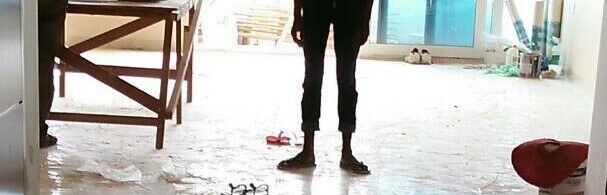
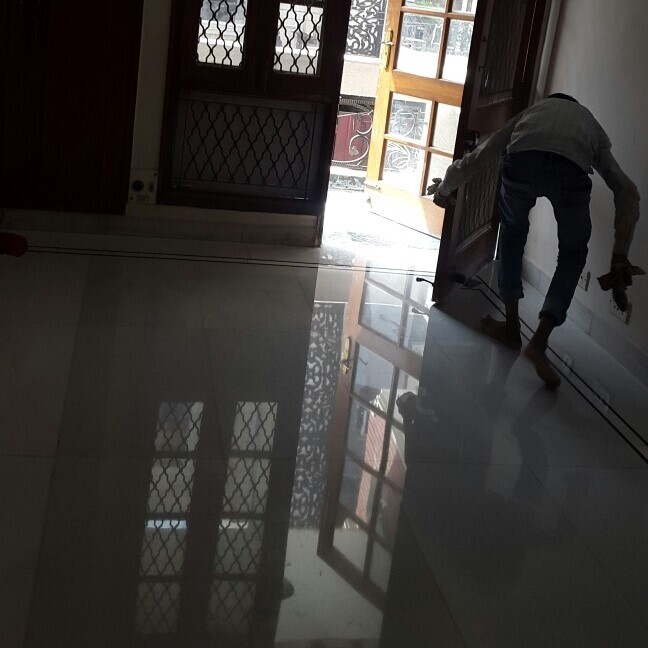
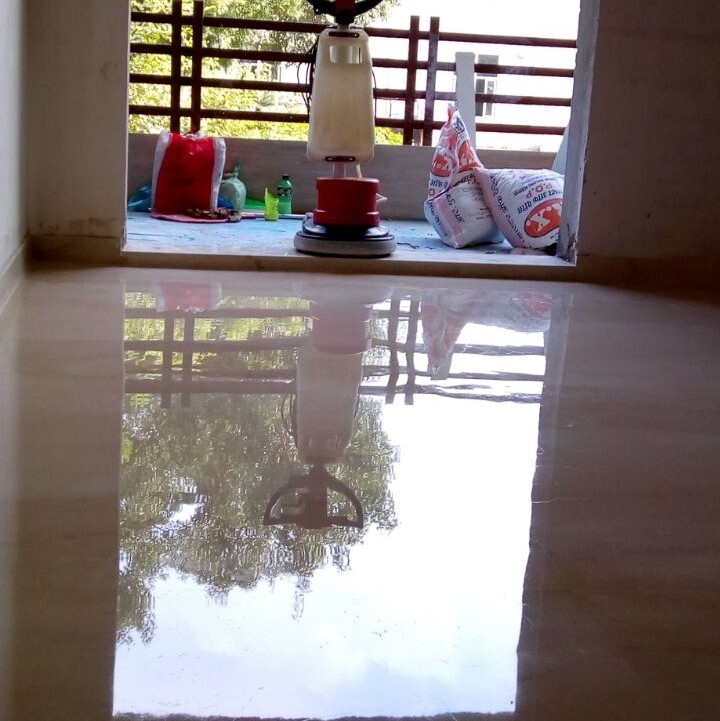
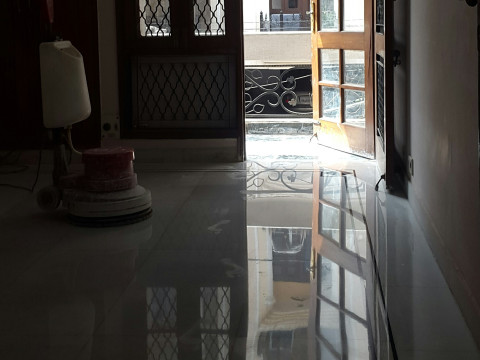
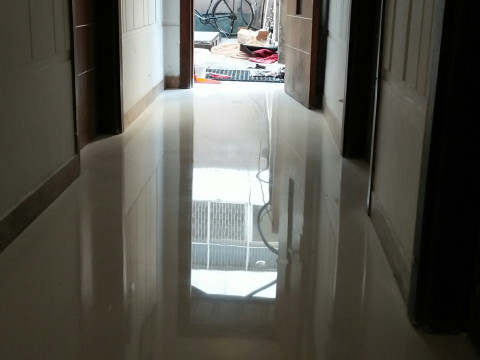
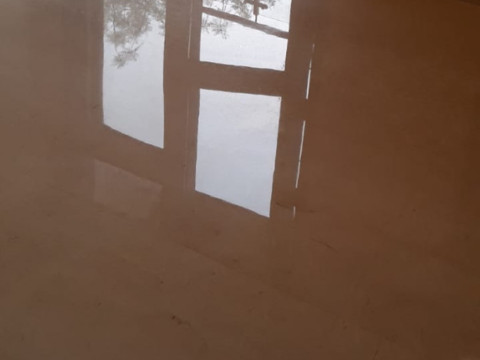
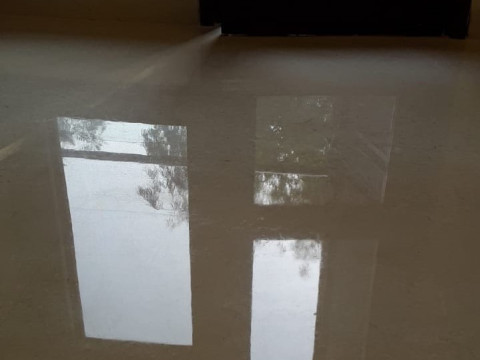
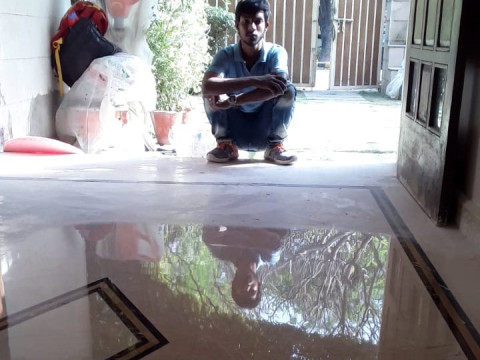
Before & after marble finish
Drag the slider to compare dull floors with restored mirror gloss.
 Before
After
Before
After

 Before
After
Before
After

 Before
After
Before
After

 Before
After
Before
After
Pricing
Janakpuri marble polishing rates
Indicative ₹/sq.ft bands — final quote after free on-site inspection.
| Package | Typical range |
|---|---|
| Basic / maintenance polish | ₹15 – ₹30 /sq.ft |
| Diamond multi-stage polish | ₹20 – ₹45 /sq.ft |
| Grinding + polishing | ₹30 – ₹60 /sq.ft |
| Epoxy fill + polish | ₹40 – ₹75 /sq.ft |
| Nano coating (optional) | ₹10 – ₹20 /sq.ft extra |
Our Process
7-step marble mirror finish method
Inspection
Assess stone, scratches and area
Grinding
Remove dull layer & lippage
Joint Filling
Glue or epoxy as needed
Diamond Honing
Pads 200 to 1500
Powder Polish
Nobile compound shine
Crystallization
Harden surface gloss
Mirror Finish
Final inspection & handoff
Neighborhoods we serve
Janakpuri coverage areas
- Janakpuri Temple Road
- New Janakpuri
- Tilak Nagar
- Old Janakpuri
- Urban Estate Janakpuri
- Hari Nagar
- Janakpuri West
- Janakpuri Bypass
- Vikaspuri
- Janakpuri College Road
- Janakpuri Railway Station
- Uttam Nagar
- Janakpuri Stadium Road
- Janakpuri Market Road
- Civil Lines Janakpuri
- Janakpuri Collectorate
Call: +91 86070 01043
Alt: +91 9466 730 013
Email: info@srmarblepolishing.com
Hours: Mon–Sun 8:00 AM – 8:00 PM
Reviews
Client feedback
Real client notes help new customers choose the right polish for their floor.
FAQ
Common questions about Affordable Marble Polishing Near Janakpuri Institutional Area Delhi-Delhi NCR
How much does marble polishing cost in Janakpuri?
Packages are quoted in ₹/sq.ft after we check stone type, damage and access. Share photos on WhatsApp for a fast range, then we confirm on free inspection in Janakpuri.
Do you handle society / RWA permissions in Janakpuri?
Yes. We share method notes, protect lifts/common areas and work in approved noise windows for gated societies across Janakpuri.
Is dust controlled during marble polishing in apartments?
We use wet grinding and vacuum recovery where practical, plus floor protection, to keep slurry and dust controlled in occupied homes.
How is the final price decided?
We confirm stone/surface type, damage level and sq.ft on inspection, then share a clear ₹ range before starting.
How long does the job take?
Most apartments finish in 1–3 days. Large commercial floors are phased around your schedule.
Do you polish Corian, onyx and remove scratches too?
Yes — Corian tabletops/counters, onyx tabletops and floors, and scratch removal on stone and solid surfaces across Delhi NCR.
Do you serve Gurgaon, Noida and Faridabad?
Yes — full Delhi NCR coverage including Greater Noida, Ghaziabad and nearby sectors.
Is furniture moving included?
Light shifting can be arranged; heavy items should be cleared or discussed before the crew arrives.
What is the cost of marble floor polishing in Janakpuri Institutional Area, Delhi?
The cost varies based on the size and condition of the floor. Contact us for a free estimate.
What is the process of marble floor polishing?
Our process includes grinding, honing, polishing, and sealing to restore the shine and finish of your marble floors.
How long does marble floor polishing take?
The time required depends on the size of the area being polished. Most projects are completed within a day.
Do you provide marble polishing services in other areas of Delhi NCR?
Yes, we offer our services across Delhi NCR, including Janakpuri Institutional Area and surrounding areas.
How can I care for my marble floors after polishing?
Regularly clean with a pH-neutral cleaner and avoid using abrasive materials that can scratch the surface.
Do you conduct inspections before providing a quote?
Yes, we offer free on-site inspections to assess the condition of your marble floors and provide an accurate quote.
How do you control dust during the polishing process?
We use advanced dust extraction equipment to minimize dust and ensure a clean and safe working environment.
Do you offer marble polishing services to residential societies and RWAs?
Yes, we work with residential societies and RWAs to provide professional marble polishing services.
Are your marble polishing products safe for use in homes?
Yes, we use eco-friendly and non-toxic products that are safe for use in residential settings.
Can you remove deep stains and scratches from marble floors?
We have specialized techniques to remove deep stains and scratches, restoring the natural beauty of your marble floors.
Do you offer maintenance services for marble floors?
Yes, we provide maintenance services to keep your marble floors looking their best for years to come.
What is the warranty on your marble polishing services?
We offer a warranty on our services to ensure customer satisfaction and peace of mind.
Can you provide references from past clients in Janakpuri Institutional Area?
Yes, we can provide references from satisfied clients in Janakpuri Institutional Area upon request.
Do you offer discounts for large marble polishing projects?
Yes, we offer discounts for large projects and customized packages to meet your specific needs.
Is marble floor polishing suitable for all types of marble?
Yes, our polishing services are suitable for all types of marble, including natural stone and engineered marble.
Do you provide maintenance tips for keeping marble floors in good condition?
Yes, we offer maintenance tips and recommendations to help you preserve the beauty of your marble floors.
We also do
Corian, onyx & scratch removal
Beyond this service — we polish Corian tabletops, onyx floors/tabletops and remove scratches across Delhi NCR.






Ready to restore the shine?
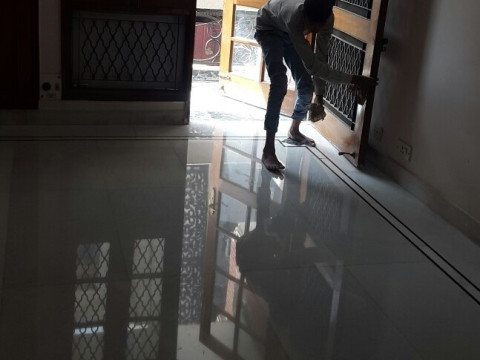
Book a free inspection for marble, Corian, onyx or scratch removal across Delhi, Gurgaon, Noida, Faridabad & Ghaziabad.