Reliable marble floor restoration for homes and small commercial properties
Marble flooring has always been valued for its clean appearance, natural shine and long life. It gives interiors a solid, premium feel that ordinary tiles cannot match. However, with daily use, even strong marble begins to show signs of wear. Dust from outside, constant foot traffic, furniture movement and regular cleaning slowly affect the top surface.
Over time, the floor starts looking dull and uneven. Light no longer reflects properly, stains become visible and scratches stand out. Many people think the stone has permanently aged and needs replacement. In reality, most marble floors only require professional polishing to regain their original look.
Proper polishing restores the stone itself rather than hiding problems. With the right machines and careful handling, the marble can be corrected, refined and protected so it stays attractive for years.
What marble polishing really means
Polishing is not simply applying wax or a shiny coating. Those solutions may look good for a few days but quickly wear off and often make the floor slippery.
True marble polishing is a mechanical restoration process.
As marble ages, it develops countless tiny scratches, etch marks and pores. These imperfections scatter light, which is why the floor looks cloudy or lifeless even after cleaning. Grinding and polishing remove a very thin layer of damaged stone. Once the surface becomes smooth and even again, light reflects naturally and the original shine returns.
The gloss comes directly from the marble itself, making it long-lasting and natural.
Common problems seen on marble floors
In residential colonies and mixed-use areas, similar issues appear regularly. Most are surface defects that can be corrected.
Loss of shine
Heavy traffic areas such as living rooms and corridors begin to look flat and faded.
Scratches and scuffing
Grit from footwear and dragged furniture create fine lines that gradually spoil the finish.
Stains and etching
Tea, coffee, oil and harsh cleaning agents leave dull patches that do not go away with mopping.
Uneven surface
Some areas shine while others remain matte, often due to old or improper polishing.
Small cracks and pinholes
Natural stone may develop tiny gaps where dirt collects, making the floor harder to clean.
These issues usually affect only the top layer, which means the marble can be restored without replacement.
Why polishing is better than replacing marble
Replacing marble flooring involves breaking tiles, removing debris and installing new stone. This creates noise, dust and disruption for several days. It also costs significantly more.
Polishing is a far more practical option.
The existing floor remains intact. Only the worn surface is restored. The process is faster, cleaner and more economical. In many homes and offices, the work can be completed within one or two days.
If the marble base is still strong, restoration provides excellent results at a fraction of the cost of replacement.
Professional methods used during restoration
Every floor is inspected before work begins. Based on its condition, a combination of the following techniques is used.
Diamond grinding and polishing
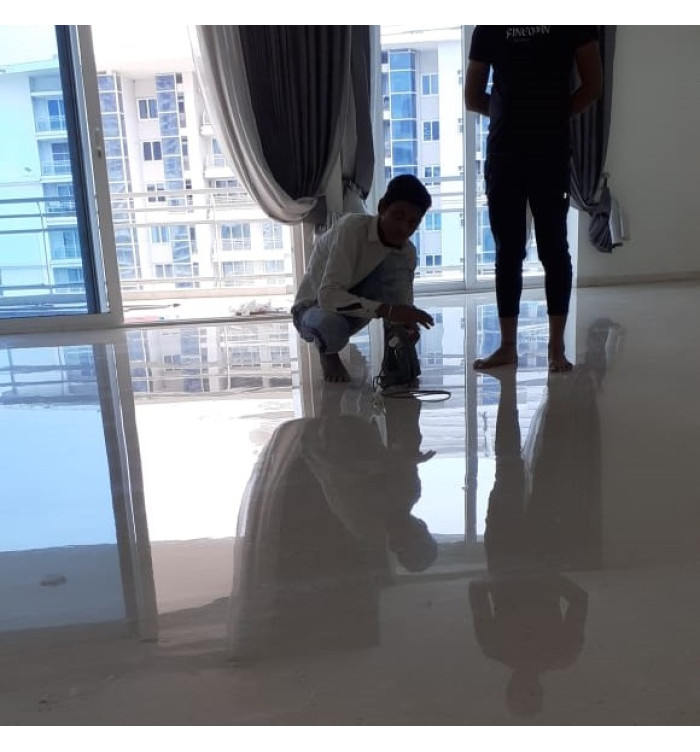
Industrial machines fitted with diamond abrasives grind the marble in stages. Coarse grits remove scratches and stains, while finer grits smooth the stone. Final polishing pads bring out a consistent, natural shine.
Silicate hardening treatment
A silicate solution reacts with the marble and increases surface density. This strengthens the floor and improves resistance to daily wear.
Nano coating and sealing
A penetrating nano sealer reduces liquid absorption. It protects against water and oil stains while keeping the marble breathable and natural-looking.
Epoxy filling for cracks and holes
Pinholes, joints and minor cracks are filled with colour-matched epoxy. After polishing, the surface becomes smooth and uniform again.
Step-by-step working process
A systematic approach ensures durable and even results.
Inspection
The marble type, thickness and damage level are checked carefully.
Preparation
Furniture is shifted or covered. Skirting boards, walls and nearby areas are protected.
Deep cleaning
The floor is thoroughly cleaned to remove dust and residues before grinding.
Grinding and correction
Diamond abrasives remove scratches, stains and uneven patches. Edges and corners are treated carefully.
Polishing
Finer pads refine the surface step by step until a uniform sheen is achieved.
Protection and finishing
Hardener and sealer are applied, and the area is cleaned and dried for immediate use.
Clean and safe work practices
Work inside homes and offices must be carried out neatly. Water-fed machines and vacuum systems help minimise dust. Slurry is collected immediately. Cables are arranged safely, and nearby areas are covered.
After completion, the space is cleaned properly so there is no leftover mess.
Suitable for different properties
Residential homes
Living rooms, bedrooms, kitchens and staircases benefit greatly from periodic polishing. A restored floor brightens the entire house.
Small commercial spaces
Clinics, offices, shops and showrooms need clean and presentable floors. Polished marble improves appearance and simplifies maintenance.
In both cases, the focus remains on durability and minimal disturbance.
Easy maintenance and long-term value
After polishing and sealing, maintenance becomes straightforward. Regular sweeping and gentle mopping are usually enough. Harsh chemicals should be avoided. Entrance mats and furniture pads help reduce wear.
Because the surface is smooth and sealed, dirt does not stick easily. Cleaning takes less time, and the finish lasts longer. This makes polishing a cost-effective long-term solution for maintaining marble floors.

Amrapali Greens- Ghaziabad

Meghdutam Apartment - Noida

Noida Sector 59

NEC Technologies

GREATER KAILASH- DELHI

Haldor Topsoe India Private Ltd- Faridabad

Unayur Marketing - Delhi

Heritage Max - Gurgaon

Alliance Constructions- Gurgaon


FREE INSPECTION

BOOKING

WORK STARTED

BEST QUALITY SERVICE

GUARANTEED SATISFACTION